The Olive Synthesizer (2025)
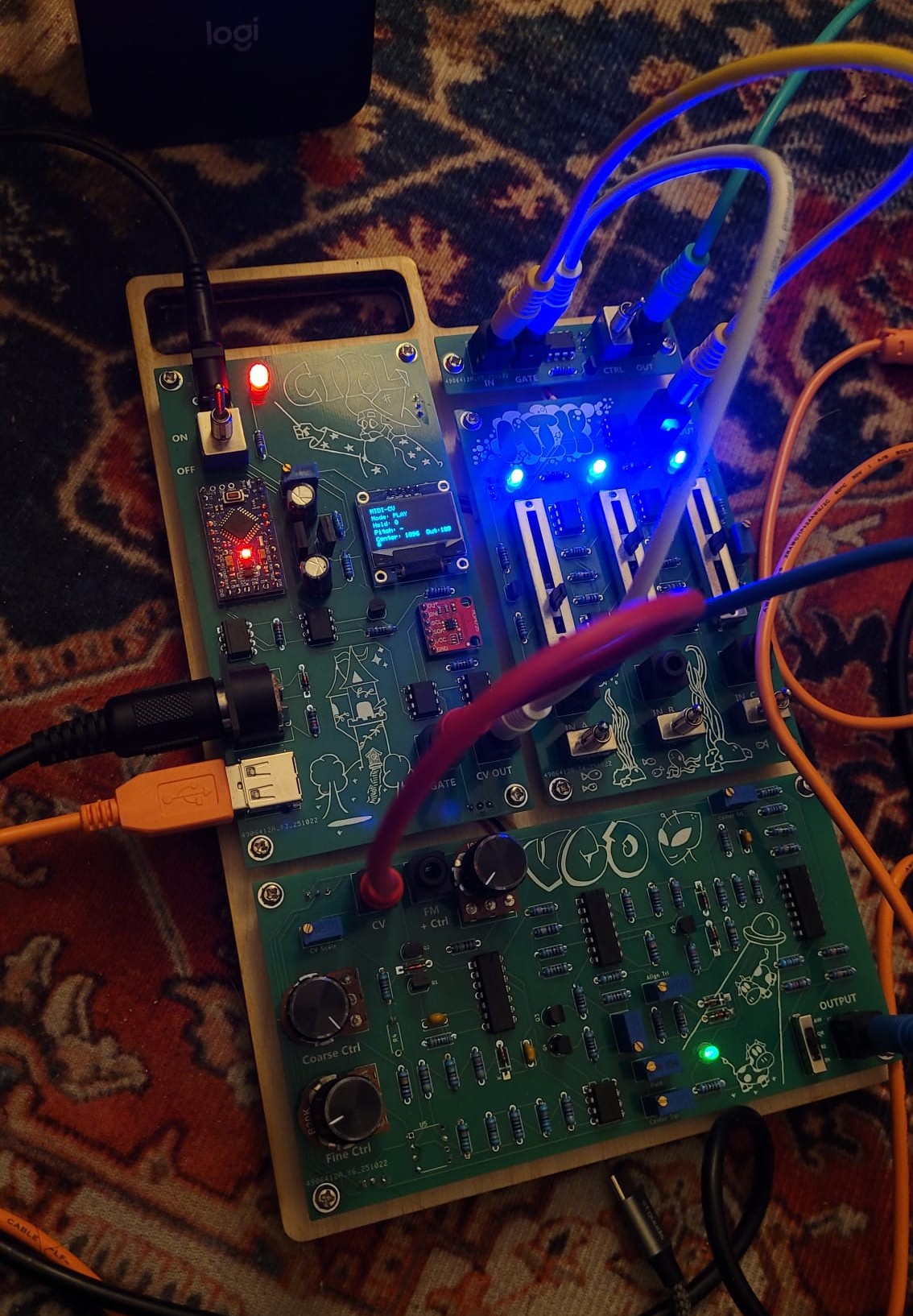
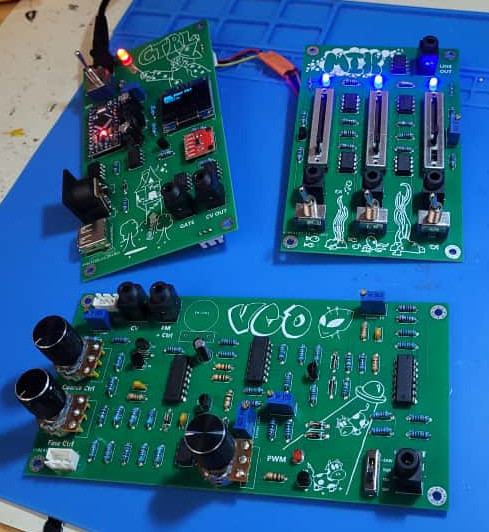
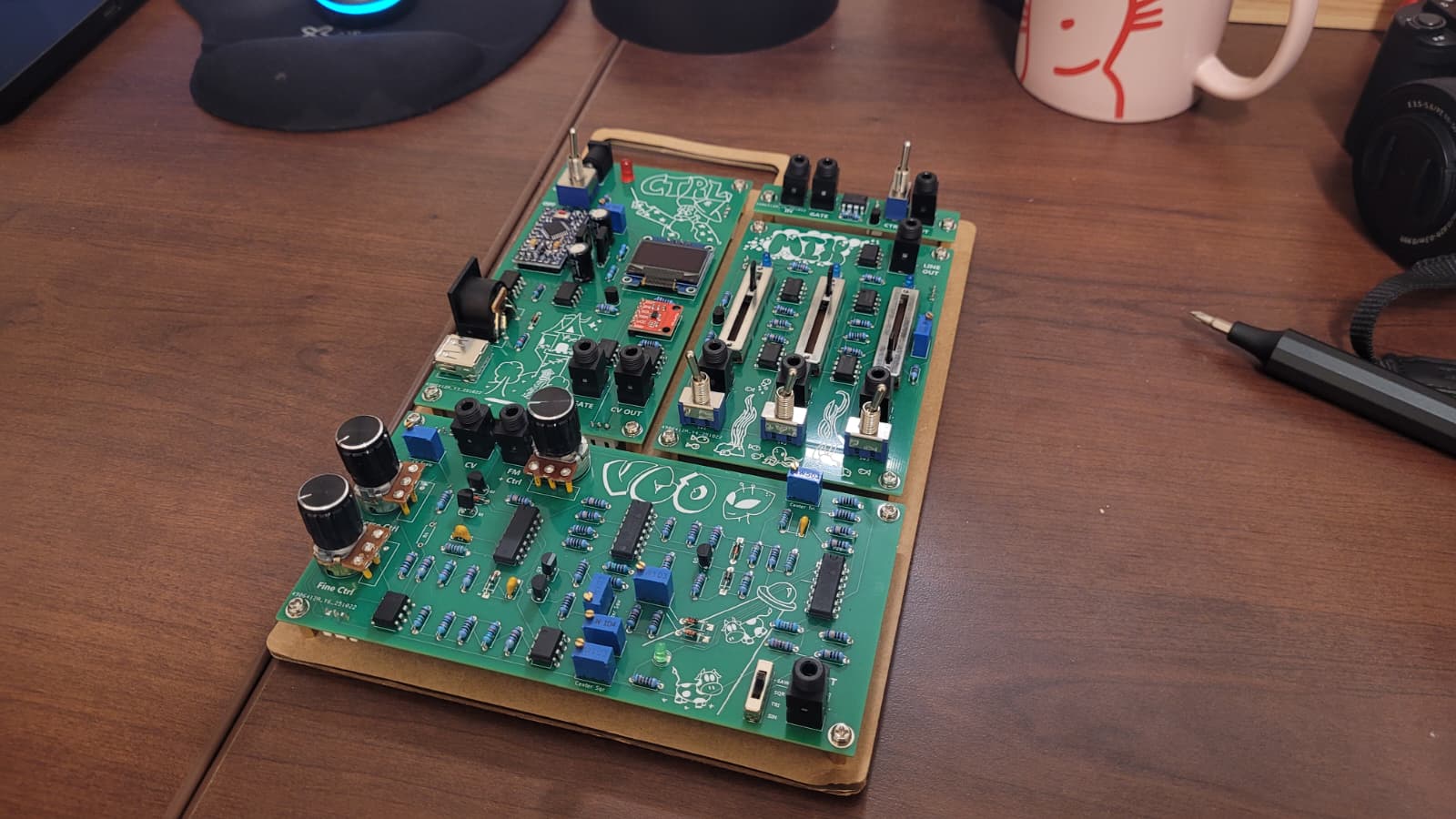
Over the past year, I’ve taken a big interest in electronic music and analog synthesis. Inspired by modern semi-modular Moog synthesizers like the Moog Mavis, I set out to build my own version: The Olive. It has grown from a simple hobby experiment into a DIY analog synthesizer that brings together a voltage-controlled oscillator, a 3-channel active mixer, and a MIDI-to-CV controller board.
overview
The Olive Synthesizer is a functional analog electronics project and a visual design object. The goal was not just to assemble a synthesizer, but to build a system where the circuit boards, enclosure, panel layout, and graphics all felt connected to one larger identity.
inspiration & motivation
To start, I should make clear that I am not a musician. I can’t play the piano, and I can barely clap on beat. My interest in this project came from three main ideas, each shaping a lot of the design decisions I made while building it.
[1] A circuit board with a personality:
Back in the 80s and 90s, engineers had a habit of hiding tiny messages within their designs. These “PCB Easter eggs” were left inside the circuitry of their devices to be discovered by other engineers (or by meddling kids trying to disassemble their toys).
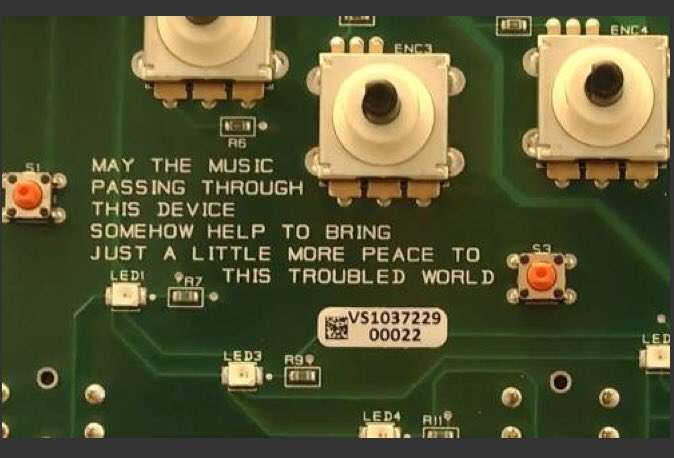
I ran into this image while scrolling through Reddit and thought about how beautiful that sentiment was: the pride that comes from knowing something you created is out there in the world doing someone some good. There is a kind of contentment in that. You may not have painted the Mona Lisa, but at least you created the paintbrush. Engineers are artists too, and should work with passion, care, and attention to detail.
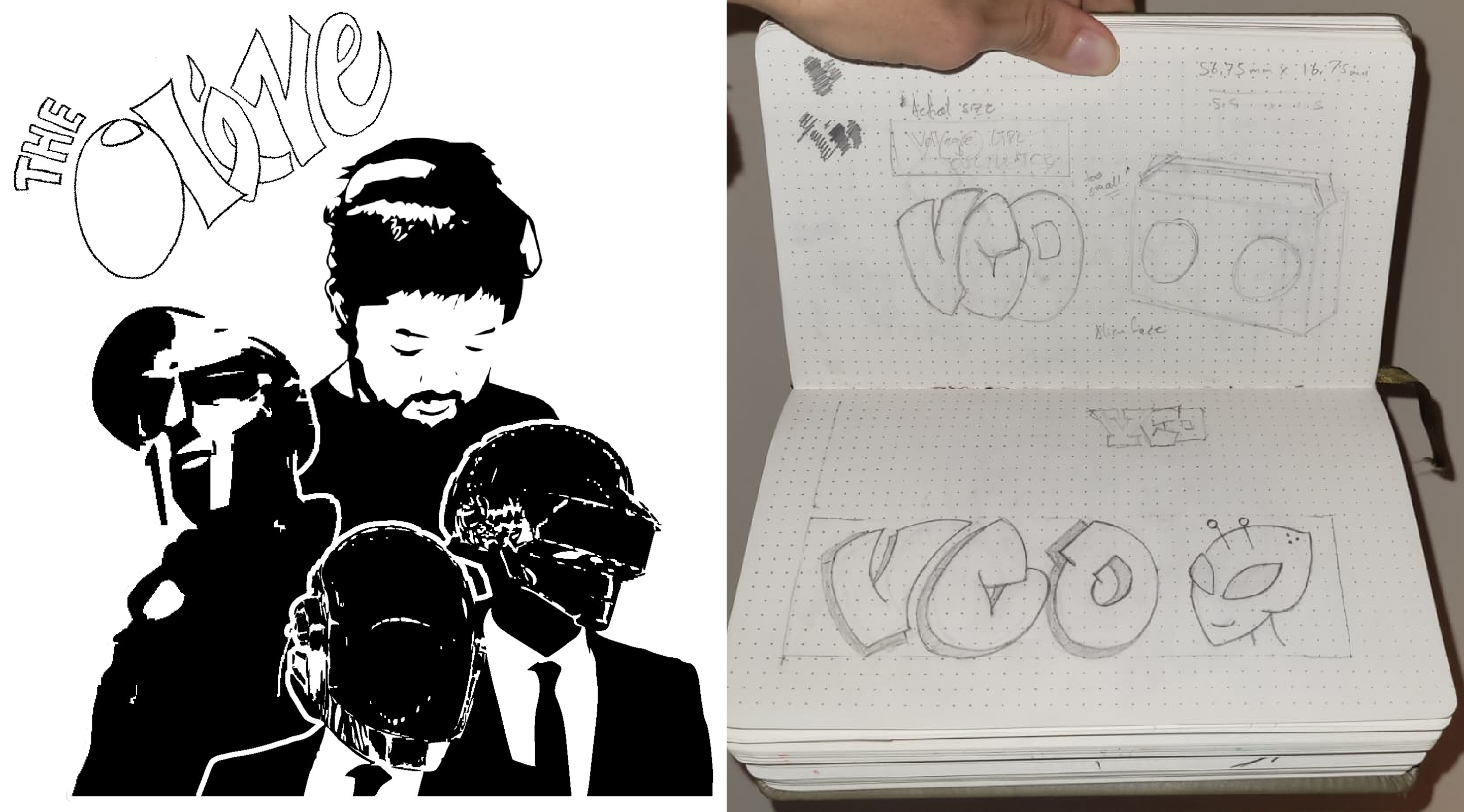
This is why I focused not only on the engineering of the project, but also on its aesthetic. Each individual module has its own custom theme: aliens for the VCO, wizards for the controller, and an aquatic theme for the mixer. The back panel of the synthesizer is also adorned with a laser-cut engraving of some of my favorite musicians, who have greatly inspired both digital music and myself.
The Olive Synthesizer is not only a functional piece of equipment, but also a work of art that I am proud to display.
[2] A machine that creates something completely new:
Around the time I started this project, a friend of mine had just begun working part-time at a local student radio in Montreal. His job involved looking over the odd music requests that came in every day. He told me that a UK dubstep artist named Burial had caught his attention and recommended that I listen to one of his projects.
Though I was not a huge dubstep fan myself, I became intrigued by his use of synthesizers to lay down basic melodies. On a piano, every song is some arrangement of 88 keys. With a synthesizer, however, you can create a soundscape that has never been heard before. It felt like you were not only painting a landscape, but also creating new colors to paint with. That piqued my curiosity and drove me down the rabbit hole of analog music synthesis.
video essay on Burial and the UK dubstep scene open →
[3] My love for analog electronics:
I have a huge appreciation for the efficiency of modern computing devices. Every year, chips become smaller, faster, and cheaper. That progress is amazing, but it can also make it easy to forget the shoulders of the giants we’re standing on.
Why would I optimize my code when I can just use a faster processor? Why would I manually design an analog circuit when I can throw a microcontroller at it and have it do the work for me?
It is important to understand how the things we use actually work. As I dug deeper, I started to admire the craftsmanship behind older analog circuits. Each resistor had a purpose. Each op-amp was part of a larger solution. Though tedious at times, I managed to keep the signal path from the wall outlet to the audio output jack 100% analog. Not to flex some engineering muscle, but because taking the time to understand it even 10% better helps me become a better designer when I move back to digital systems.
functionality
The Olive currently operates across four selectable waveshapes and sustains a volt-per-octave standard up to 2 kHz. It is compatible with industry-standard Eurorack modules and semi-modular synthesizers operating on a ±12 V range. The MIDI-to-CV controller board connects to any off-the-shelf MIDI keyboard or controller through a standard 5-pin DIN cable.
final thoughts
I really wanted to challenge myself with this project. I had never designed a PCB before, much less an entire synth, yet I was determined to bring this one to completion, less for the project itself, and more to prove to myself that I could. I’ve been working on the Olive for close to a year and being able to finally hold it in my hands and show it off to people gives me a sense of pride that's hard to describe. I’ve enjoyed everything from the technical challenge to the aesthetic choices that went into it and hope people will like it just as much as I do :)
credits
design, electronics, fabrication, and documentation: Diego Oliver
modules: voltage-controlled oscillator, active mixer, MIDI-to-CV controller board
Special thanks to Lübeck Villaseñor, The Wondry, and Dr. David Owens